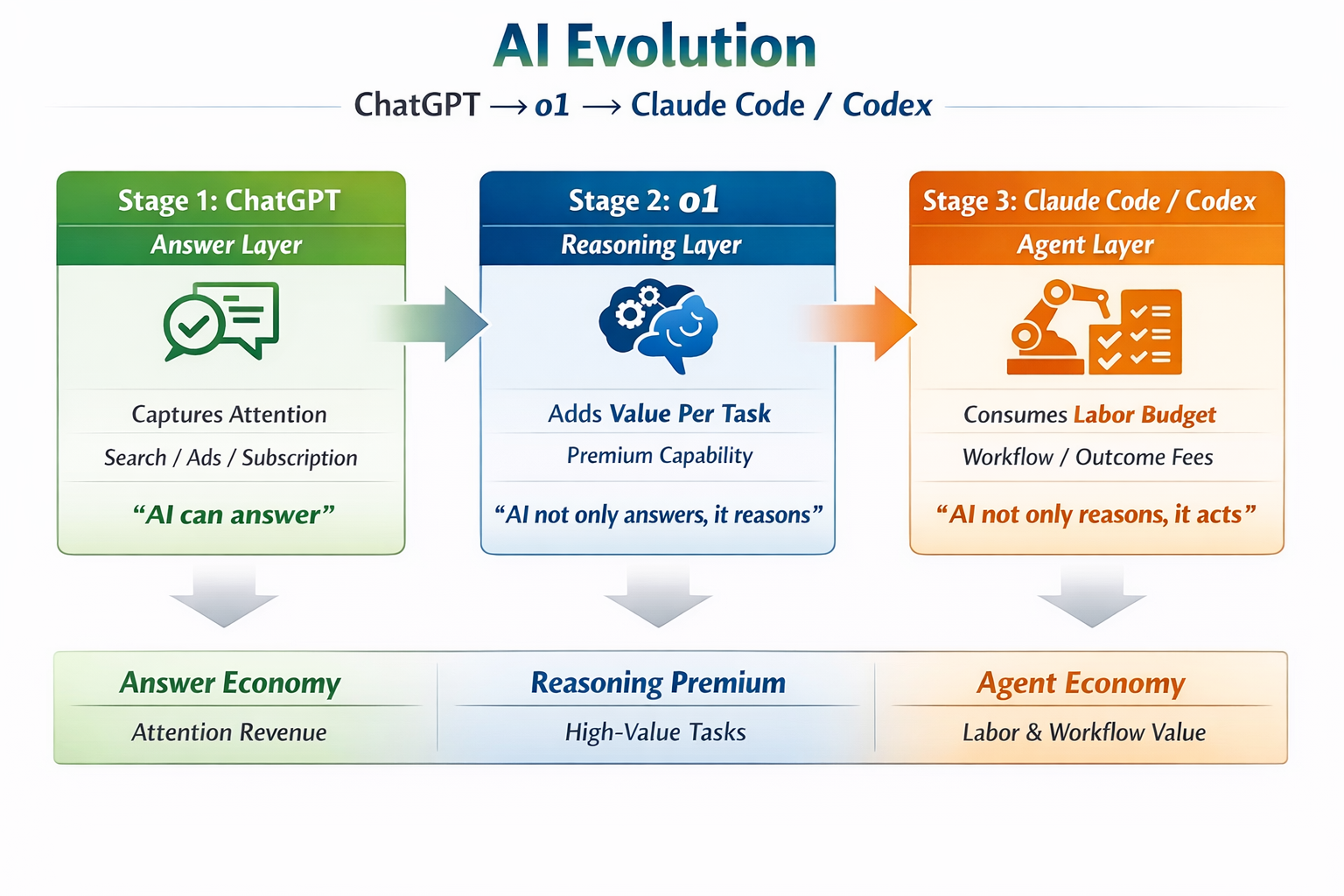
AI Answers Monetize Attention. AI Agents Monetize Labor.
News :
Ben’s latest newsletter outlines the key milestones of the LLM paradigm shift:
ChatGPT 3→ LLM becomes usable (interface)
ChatGPT o1 → LLM can reason
Opus 4.5 + Claude Code / Codex → LLM becomes agents that can execute tasks
At the same time, Claude Code and ChatGPT Codex have seen one of the fastest growth curves since Jan 2026.
And this week, OpenAI is doubling down on enterprise deployment.
Why this matters?
We are seeing two distinct monetization layers emerge.
AI is splitting into two economies:
If we look at the graph, Stage 1 and Stage 3 is where AI can start monetizing
1. Answer Economy (Stage 1)
AI answers. This is still the attention economy, just that attention is now inside LLM interfaces.
What gets monetized is intent. Same playbook, new surface:
Ads
Sponsored results
Affiliate
Checkout
👉 ChatGPT vs Google happens here
2. Agent Economy (Stage 3)
AI does work.
This is a new economy where AI is monetized based on completed tasks (labor):
Resolved tickets
Qualified leads
Processed claims
Deployed workflows
👉 ChatGPT / Claude vs SaaS / BPO / Services happens here
What about Stage 2?
Reasoning (o1) is not a monetization layer.
It is a capability unlock.
It increases value per task, but does not define a business model by itself
What’s next
Now that both monetization paths are clear:
Attention path → answers → consumer attention / intent → ads
Work path → agents → enterprise workflows / contracts → labor + software budgets
Both models will likely mature quickly over the next few months. AI companies cannot keep spending at this pace without proving revenue traction soon.
For AI content licensing, the first monetization path will most likely come from AI answers, before later expanding into AI agents.